
By LYNETTE SOWELL
Cove Leader-Press
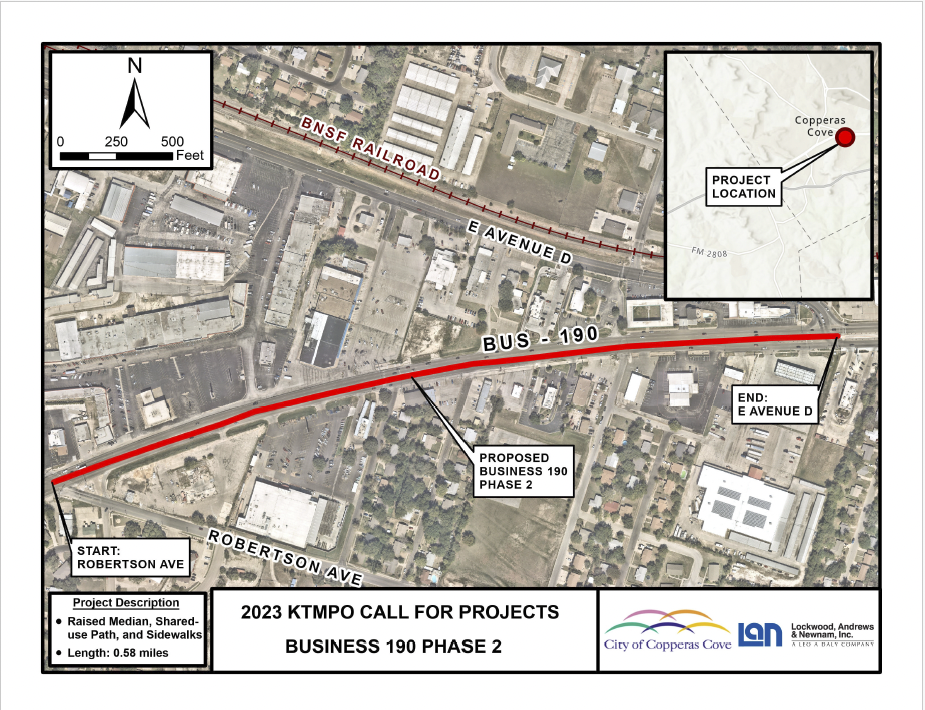
More medians, covered drainage, and sidewalks will be coming to Business 190, in the second of five phases.
On Tuesday evening during the Copperas Cove city council workshop, the council heard a presentation from Bobby Lewis, Director of Development Services.
On the list of upcoming transportation and roadway projects are four more phases of median, drainage, and sidewalk work to be done along Business 190.
Phase 2 of the medians which also includes covered drainage and sidewalk installation will start from the intersection of Business 190 and Avenue D and go west to the intersection of Robertson Avenue.
City Manager Ryan Haverlah told the council that the Texas Department of Transportation is prepared to draft an Advance Funding Agreement with the City of Copperas Cove for the second phase of the project. On Tuesday, Haverlah wanted to confirm with the council that this is the direction they still wanted to go with the project.
He acknowledged the complaints expressed by residents about making U-turns at the turn areas and being unable to see around another vehicle also attempting to turn in the new medians on Business 190, as well as complaints about the lack of landscaping on the medians as installed.
“If City Council supports these projects, we’re going to move forward, and we’re going to build out our future capital planning, financial planning, based on these projects and where they sit and where the funding is needed, so we can get these projects moving forward as they’ve been scored and as they’ve been funded through KTMPO. If City Council doesn’t support these projects, I need you to tell me so that I can work with our team to work with KTMPO on revisions to these projects. Right now, they do include the median.”
Haverlah also said that the original project has a 120-foot right of way, and in many cases that is wider than the road surface itself.
“There are current private activities happening that will no longer be able to occur in the TxDOT right of way,” he said. There are portions of the right of way which encroach on the parking lots in some area.
“There are drainage concerns, and some of those areas have been used for parking, and it’s been for years, decades. But as we continue to try and improve our city, our community, particularly on our most traveled thoroughfare throughout the city to make improvements, sometimes there’s some things that occur that people don’t always appreciate or like in that moment.”
Haverlah said the City reps went through a similar process in Phase 1 of the project and spoke with individual business owners on Business 190.
“Closing the drainage is a significant benefit by not having that amount of water, especially when it rains heavily, running right in front of your business."
Lewis also commented on the drainage issues and also the issue with the slope into Cove Terrace Shopping Center.
“If you’re driving into Cove Terrace, you kind of have to drive up on an angle, not straight up.. The first week I was in town, brand new to the city, I bottomed out the back of my car," said Lewis.
The council agreed with the suggestion of having at least one town hall to receive input from the public, because Haverlah said that TxDOT had already asked about the City’s plan for “public engagement” on the project.
Councilmember John Hale suggested to hold the meetings in April, and the council would make recommendations for any changes to the project by early summer.
If the City Council requests any scope changes, the city would need to work with the engineer to rescope and cost projects for resubmission to the KTMPO for projects and evaluate scoring impacts on the remaining phases, such as if the medians were removed from the project proposals and just drainage and sidewalks addressed.
The Business 190 Phases 2, 3, 4, and 5 have been part of the project listing that was submitted to the Killeen Temple Metropolitan Planning Organization, also called KTMPO. KTMPO receives project requests from cities and counties in the area, and these cities and counties also have representation on that board. Funds for the central Texas area project come from state and federal roadway funding that is awarded to the region.
- Log in or Subscribe to post comments.