
By LYNETTE SOWELL-STEVENS
Cove Leader-Press
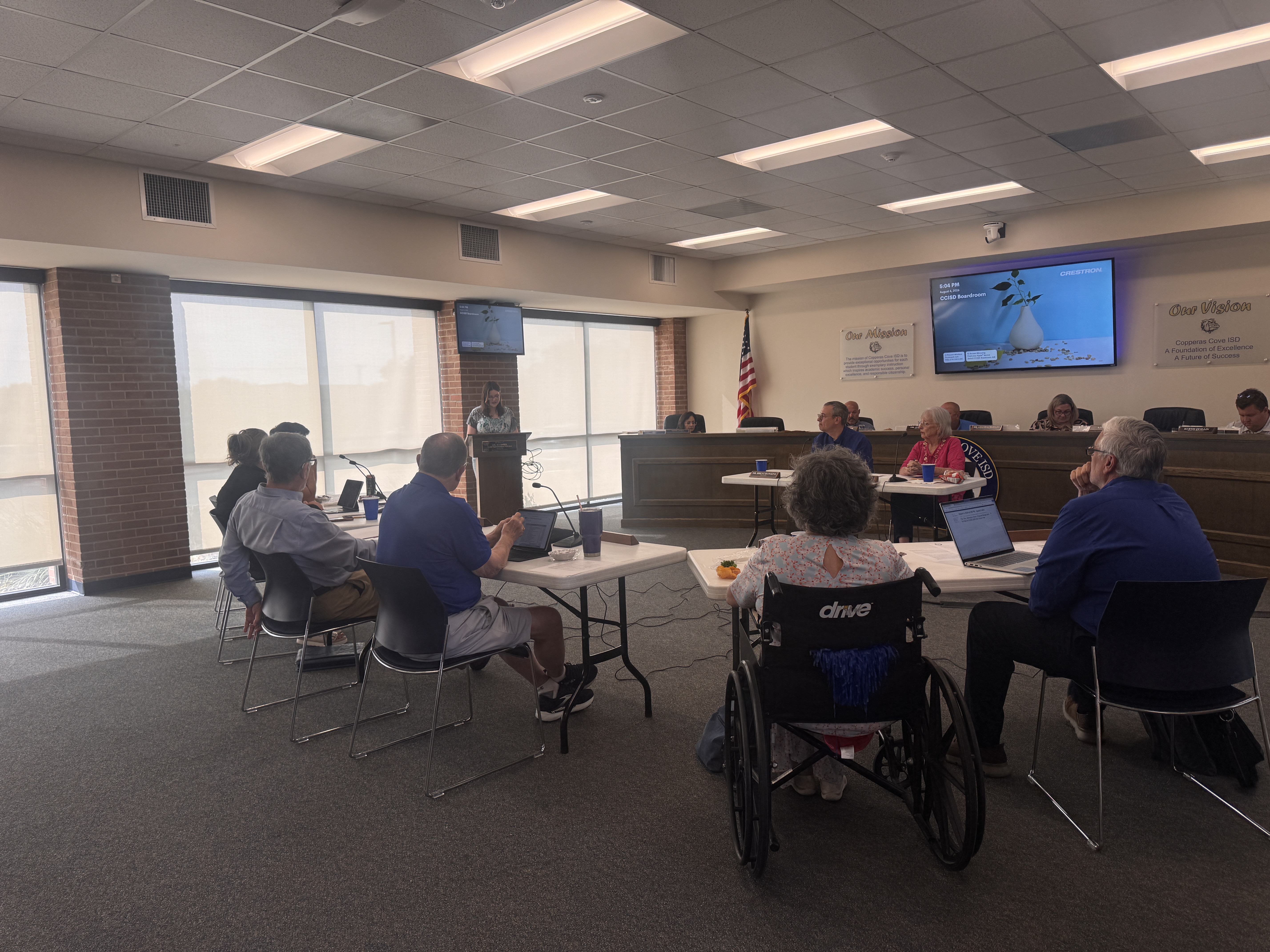
Two students from Copperas Cove High School, a senior and a junior, took the time to address the Copperas Cove ISD board of trustees during last week's special meeting on Aug. 4 regarding not just the district’s dress code, but its equal enforcement, particularly at the high school campus.
Angela Hernandez Lopez is entering her senior year at CCHS.
She expressed her concern that policies be “applied consistently” for students.
“The problem is specifically on (the district) Facebook page. In school materials, there are multiple pieces of publishing content to see with students that are not in dress code,” said Hernandez Lopez, adding that she felt that if there is a policy, it should be applied consistently and without any judgment.
“I’ve tried to talk to the high school about certain concerns when it comes to policies being consistently and purposely applied by staff members, and they all said to bring it up to the school board.”
Superintendent Brent Hawkins thanked her for coming. He encouraged her to contact the new principal of CCHS, Jeff Shannon, and set up an appointment.
“I don’t disagree with anything you say. But I also say this, is that I know that in my 34 years in education, every time a principal changes a building, the culture changes as well, and so I think it would be a good opportunity for you to proactively visit with Mr. Shannon and tell him what your insights are and then let’s allow him an opportunity to address that,” said Hawkins.
Next up was Amelia Holloway, who introduced herself as a 16-year-old incoming junior for the 2026-2027 school year. She also wanted to address the school’s dress code.
Her initial focus was on the prohibition of students wearing durags on campus.
“The policy classifies durags as just another type of head covering and bans them. Durags are not just head coverings; they are used for hair protection and maintenance to keep textured hair, waves, braids, and locs healthy and in place,” said Holloway. ““Durags are not just for hair protection; they also have a strong cultural significance. Head coverings have a long history in Black communities, and the modern durag has become an important tool for hair care as well as a symbol of Black culture and identity.
“So. why are we banning them? They are a part of Black culture and identity, so how does this affect our classrooms? I believe this policy reflects a misunderstanding of the cultural and practical purpose of durags. Although the policy may not have been intended to target Black students, it disproportionately affects them because durags serve a unique cultural and practical purpose.
“Some could reasonably view a policy like this as a microaggression because of its unequal impact. The post even misspelled durag, which suggests this policy may have been created without fully understanding the item that is being banned.”
Holloway also talked about the way the dress code classifies the fit of a student’s clothing.
“Secondly, the post states that you cannot wear tight or and/or revealing clothing or accessories that may draw undue attention to the student. What exactly does undue attention mean? If clothing that simply fits my body is considered distracting, what message does that send to students whose bodies naturally attract attention? Why should they be expected to hide their bodies because of how they were born? A dress code should address clothing choices, not punish students for body types they cannot control.”
Her address then shifted to the consistent enforcement of the dress code, as did Hernandez Lopez. She pointed on specific times when the campus’ Facebook page posted a photo, and a student was wearing something not in compliance with dress code.
“I would also like to raise attention to the obvious bias when it comes to enforcing these policies. On October 3, 2025, the Copperas Cove High School official Facebook page shared photos from our annual Pink Out pep rally. If I am correct, the fingertip length roll for shorts was in effect then, just as it is now.
“In one of those photos, three students are pictured wearing pink. The student in the middle appears to be wearing shorts may not extend to her fingertips, yet she was not dress coded and even featured on the school’s official page.”
The photo Holloway referred to shows three female students. The center student is wearing a white cropped top with her navel and midriff showing, and wearing black shorts that come to the top of her upper thighs. Over the shorts is a thin, sheer tutu of pink that is shorter than the shorts.”
Holloway said that two months earlier, on August 15, 2025, one of her classmates shared that she had been dress coded for wearing shorts, her fingertips barely reaching the hem of her shorts. The classmate was removed from class and had to sit in the office to wait for her parents to pick her up.
“When students see situations like these, it raises an important question: Why was one student allowed to wear similar clothing while another was disciplined? Inconsistent enforcement creates a perception that students with certain body types are held to a different standard, which does not create a fair or welcoming learning environment,” Holloway said.
“If dress code policies are going to exist, they should be enforced consistently and equally for every student. I speak not only for myself, but for many other students, when I say that we want equal treatment, clear policies, and consistent enforcement. We deserve a dress code that respects students of all cultures, all body types, and applies the same standards to everyone.”
Superintendent Hawkins also thanked her for coming.
“It’s good to hear something that people are for, because we come and hear everything that people are against, and I think that’s important in society that we’re actually for something.
“And we’ve heard loud and clear between the both of you: equal enforcement is important to you, and so you’re to be commended for that. And again, reach out to Mr. Shannon. I do say this as far as a dew rag, I personally grow one myself. I’m a bow hunter.
“So you know, the opinions of dress code, there’s over 40,000 people in our community, and so everyone has an opinion on dress code. But at the end of the day, I know that Mr. Shannon is going to set up a student advisory committee, and I would say that’s something that you probably should ask to be on, volunteer, get on that student advisory committee, so that you can shape those policies.”
- Log in or Subscribe to post comments.