
By LYNETTE SOWELL
Cove Leader-Press
The Copperas Cove city council directed the City of Copperas Cove administration to move forward in exploring the possible formation of a tax increment reinvestment zone somewhere within the city.
A tax increment reinvestment Zone (TIRZ) in Texas is a designated geographic area.
The city council would designate this area to attract new investment and help improvements in that area.
A TIRZ creates a fund from property tax financing to pay for things like public infrastructure improvements such as roads, utilities, and parks. The TIRZ is not a “new tax” but a way for cities to target improvements in specific areas.
The money that comes from the incremental tax funding can only be used in that area.
A TIRZ has a time limit that is set by the council. For example, the City of Belton has a TIRZ and its term is 30 years.
When a TIRZ is created, taxable value of property in the TIRZ is considered the base year value.
As time goes on and the TIRZ property value rises – which means that tax revenue also rises within the TIRZ, the “increment” taxes above the original base value are put into a fund for the zone to pay for the improvements as the area is developed.
The specific location of a possible TIRZ within Copperas Cove has not been finalized.
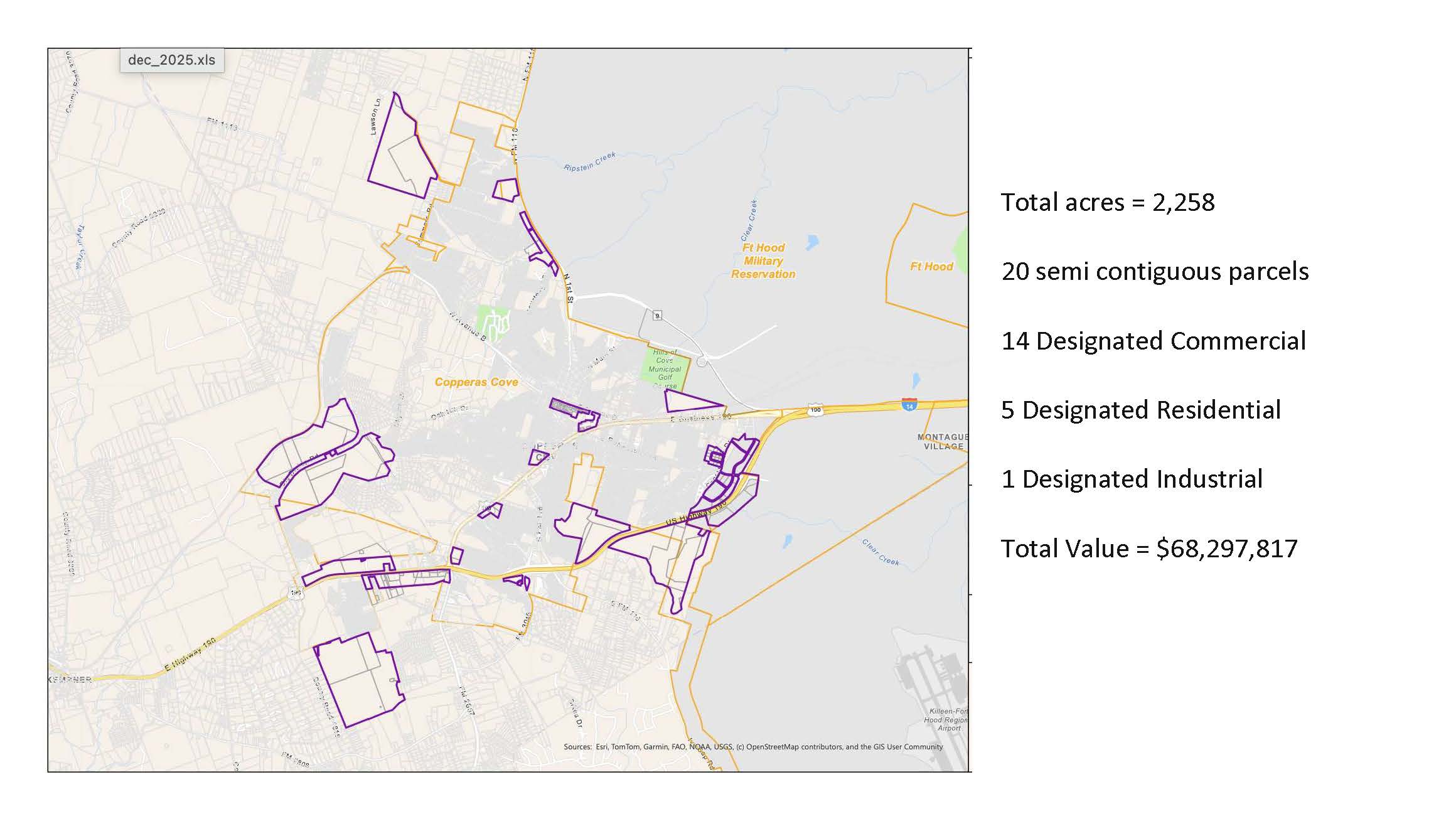
The council was presented with a map that highlights areas that could be turned into a TIRZ.
Bill Calderon with Calderon Economic Strategies, LLC was consulted by the City administration on the creation of a TIRZ and Calderon explained the concept and areas to the council.
The majority of the 20 prospective parcels of land, 14 are along commercial corridors like Business 190, and there are five residential parcels included. The remaining parcel is industrial.
This makes up a little more than 25 acres of land within the city that could be used for a TIRZ.
“The total value, based on our GIS analysis of the land within this proposed boundary, is just over $68 million today on the issue of the residential parcels when we started this process, “said Calderon.
“One of the things I recommended to staff and as we talked about it, there was consensus that we include at least one, if not multiple, residential parcels of land in the reinvestment zone.”
Calderon called the TIRZ a tool that works well, but “they have to have an economic engine to work.”
He indicated that with the VA Clinic coming, this would help with the economic engine concept.
“I suggested to staff that, since there was not a demand on the city for resources to be reimbursed to them for infrastructure, that perhaps it would be a good parcel to include,” Calderon said. ”Staff thought it a good idea to look at some of the other soon to be developed residential parcels of land to take advantage of that future incremental value to further the development along your commercial corridors, specifically in the downtown area where we didn’t have any any large projects that would generate a lot of money.”
The TIRZ tool could be used to negotiate with residential developers for a myriad of things that they may not otherwise do, enhanced landscaping, enhanced green spaces, and public facilities.
Calderon estimated the incremental revenue would total just over $623.9 million over 30 years.
The council did concur to move forward with looking into creating a TIRZ in the city.
Council member Jack Smith, however, noted that he believed the proposed area of the TIRZ was too large.
“We have properties that are already scheduled for development and already approved for development, and basically it’s going to take 50 percent away from the operating budget of the city and go to a board that’s not even created yet,” Smith said. “So, some of these properties, I think may need to be looked at. I think it’s too many and too much property.”
City Manager Ryan Haverlah explained that a TIRZ wasn’t actually taking money from the general fund.
“Including those properties doesn’t just take away funding from the general fund, because a number of the projects that can be funded through this are those general fund type projects,” Haverlah explained.
“The revenue stream from the TIRZ will be used as a catalyst for future development to occur faster, which is actually growing our tax base at a faster rate than we have previously seen.”
Calderon then shared how the TIRZ funds don’t have to stay in that fund, but the agreement can be worded to allow for some of the funds to be transferred back into the general fund.
“This was done very specifically to address Houston concerns because of the number of reinvestment zones that were in play at one point in time. There’s over 28 of them now,” he said. “What we did was add language to the statute to tap the reinvestment zone pot, to redirect revenues into the general fund to cover any myriad of either service issues, maintenance issues, that might otherwise come from your general fund.”
Smith thanked them for the clarification.
“I was just worried that we would run out of money to pay the firefighters and police by taking 50 percent and putting it in a fund to help future development, and I just didn’t want to see that happen.”
Next steps having discussions with both Coryell and Lampasas County reps. There will also be a published notice for a public hearing. The TIRZ is also required to have a board of directors appointed. The board would be seven members, possibly five from the city and one each from the counties.
- Log in or Subscribe to post comments.